Vinayaka Chaviti (Ganesh Chaturthi) |
2001 Vinayaka Chaviti Celebrations Gallery from Hyderabad & Secunderabad
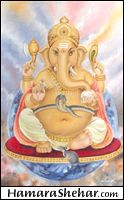 Vinayaka Chaviti – also known as Ganesh Chaturthi – the festival of the god Ganesh or Vinayaka, is celebrated as the birth anniversary of Ganesha - the god of wisdom and prosperity. It is celebrated on the Suddha Chaviti day (the fourth day after the no-moon day) of the lunar month Bhadrapada (August/September).
Ganesh's blessings are invoked at most religious ceremonies as he is the god who can remove all obstacles to success. He bestows wisdom, good fortune and prosperity and ‘helps’ preventing natural calamities.
Ganesh Chaturthi, marking his birthday, is celebrated in his honour, chiefly in the states of Maharashtra, Tamil Nadu, Karnataka and Andhra Pradesh. In Mumbai alone, thousands of Ganesh idols are commissioned collectively by social, cultural and commercial organisations.
This festival is so popular that preparations begin months in advance. Chaturthi is the last of the eleven days dedicated to the elephant-headed god, when thousands of processions converge on the shores of lakes, ponds, and sea beaches to immerse the holy idols in the sea. Hussain Sagar in Hyderabad and Chowpatty beach in Mumbai are principal places where the idols are immersed at the end of the festival. The immersion of the idols takes place amidst the chanting of "Ganesh Maharaj Ki Jai!" and "Ganapati Bappa Morya". The festival ends with pleas to Ganesh to return ‘early’ the next year.
He is the god of wisdom and prosperity and is invoked before the beginning of any auspicious work by the Hindus. When a Hindu child is initiated into education, (s)he is asked to invoke Ganesha by chanting the Mantra – “Om Sree Ganeshaya Namaha” - only then is the education considered ‘commenced’.
Ganesh Utsav
This very social and colourful festival has an interesting beginning – in Maharashtra, where its popularity knows no bounds.
The ten-day festival starts from the fourth day of the bright half of the lunar month, Bhadrapada and continues till the fourteenth day. Thousands join in and form the many processions that fill the streets when the time comes for the image to be immersed in a water body - the sea, river or a lake. The festival brings with it a feeling of caraderie.
On the first day the clay form of Ganesh is brought home with great devotion. Prayers are said and songs chanted to the accompaniment of music from the mridanga or two-sided drum and the jhanj or cymbals. Some devotees select and buy their Ganesh on the same day and others place their orders months in advance. The figures are often very large, standing several metres high. These larger Ganesh images are usually ordered by neighbourhood puja committees, the entire neighbourhood contributing towards the purchase.
After the idol is collected it is ceremoniously installed in a place of honour and various rituals take place. The Ganesh is decorated with ornaments, flowers and lights. Puja and aarti are performed every morning and evening using flowers, rice, betel nuts and leaves, turmeric, red powder, coins and oil lamps. Men and women, the old and young all join in. Special sweets called modaks are steamed or fried for offering to Ganesh. Modaks are small rice or wheat flour dumplings stuffed with coconut and jaggery. These are served at the festive meals during the festival.
On the tenth day of the festival is immersed in water. Huge processions made up of different groups all accompanying the image of Ganesh that they have worshipped, make their way by foot to the immersion site. The very large images are transported by truck. All this is done to the accompaniment of dancing and singing. The mood is jovial with everyone chanting, over and over again, "Ganesh Bappa more ya, Pudhchya Varshi Lavakar Yaa..." calling Ganesh to come again soon next year.
The sight of the crowded streets, the different Ganesh images and the happy people is an amazing spectacle. In large towns special roads are demarcated for these processions and the traffic police and users of cars, buses and two-wheelers display notable patience with the crowds and never-ending processions.
However, it is the stupendous scale of this festival, celebrated by communities of people in the cities and villages of Maharashtra, which attracts millions of people to the state. Some of the community idols are as tall as 20 metres. These are set up in large pandals, worshipped for up to ten days and then taken to the sea in immense processions for immersion.
Rituals
The festival preparations start early in the day, well before sunrise. People get ready with all the items needed for the Vinayaka Vratam (the ritual associated with worshipping Vinayaka on this day). They include specific varieties of leaves, flowers, fruits, incense sticks, sugarcane pieces, coconuts and other items normally used on festive occasions. A small square, made with thin bamboo sticks, called Palavelli, is hung above the idol of Vinayaka and decorated with Lotus flowers, various leaves and fruits.
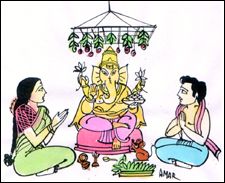 The idol of lord Vinayaka is normally made of clay and is placed in the north-eastern direction of the house. The idol is placed on betel leaves that are placed over a small heap of rice or other grain. Before worshipping the main idol, a small idol form with turmeric powder is worshipped. Then the holy lamp is lit and the Pooja commences. It is believed that the number twenty-one is dear to Vinayaka and hence he is worshipped with the same number of flowers, fruits and is offered twenty one varieties of special food preparations.
Lord Vinayaka is said to be very much fond of "Undrallu" (a sweet made with rice flour), which are invariably prepared in every household on this festive day. Ghee – clarified butter – made from cow’s milk, is used in place of cooking oil on this day in the preparation of food items.
Children keep their books near the idol this day to seek the lord's blessings towards their studies. Likewise, people of different trades keep their tools of the trade etc. near the idol to seek blessings. It is believed that by worshipping Vinayaka, hurdles in life are cleared and the mental faculties of the devotees are improved.
On this festive day, children go around the neighbourhood visiting houses to ‘view’ the Vinayaka idols and offer prayers to Ganesh.
During this multi-day festival, as long as the idol is kept in the house, prayers are offered daily in the mornings and evenings. It is customary to immerse the idols in a water body like a river, pond or lake, on the third, fifth, seventh, ninth or eleventh day.
In the country side, farmers bring back a small portion of the clay from the idol after immersion and place it in their granaries. The belief is that the clay prevents mice from foraging into the granaries. Instead of leaving the idols in a water body, some devotees keep them in their granary for prosperity.
|