|
(Zingiber Officinalis)
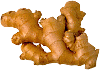 Ginger, a perennial herb with
an aromatic, knotty, fibrous rootstock, has a tan skin and a flesh that ranges
in color from pale greenish yellow to ivory.
An ancient Indian proverb states that everything good is found in ginger—"vishwabhesaj"
a universal medicine.
This extremely versatile root has long been a mainstay in Asian and Indian
cooking and found its way early on into European foods as well.
Ginger is one of the most popular herbs in the world.
Also Known As
Pharm | Rhizoma Zingiberis |
Assami | Ada |
Bengali | Ada |
Farsi | Jamveel, Zanjabil |
Gujrati | Adhu (fresh), Sunth, Shuntya (dried) |
Hindi | Adi, Adrak (fresh), Sonth (dried) |
Kannada | Alla (fresh), Sunthi (dried) |
Malayalam | Inchi |
Marathi | Sunth, Shuntya (dried), Alha (fresh) |
Oriya | Ada, Adraka |
Sanskrit | Ardraka (fresh), Shunthi (dried), Shringaveran, Sringaaran |
Singhalese | Inguru |
Tamil | Ingee |
Telugu | Allam |
Urdu | Adrak |
|
Plant Family
Zingiberaceae (Ginger family).
Origin
Central Asia. (50% of the world's harvest is produced in India.) Brazil, China, Mexico, Jamaica (best quality) and Nigeria (rather pungent, but lacks the fine aroma.) Most ginger is exported from Jamaica.
Indications
Atherosclerosis, chemotherapy support, menstruation, painful (dysmenorrhea), migraine headaches, morning sickness, motion sickness, nausea, vomiting (and nausea, post-surgical) and rheumatoid arthritis.
Etymology
The names of ginger in most languages derive (via Prakrit singabera) ultimately from Sanskrit "shringavera": "shaped like a deer's antlers (horns)", from "shringan": "horn". Greek ziggiberis and Latin zingiber (vulgar Latin gingiber.) The Old and Middle English forms gingifer and gingivere relate to Old French gingivie.
Sensoric Quality
The flavor is refreshing, peppery, lemon-like and slightly sweet, while the aroma is pungent and spicy.
Part(s) Used
The large, fleshy rhizome (the underground stem).
Tips
Fresh ginger is available in two forms--young and mature. Young ginger, sometimes called spring ginger, has a pale, thin skin that requires no peeling. It's very tender and has a milder flavor than its mature form. Mature ginger has a tough skin that must be carefully peeled away to preserve the delicate flesh just under the surface. Mature ginger with smooth skin is preferable (wrinkled skin indicates that the root is dry and past its prime).
Fresh unpeeled gingerroot, tightly wrapped, can be refrigerated for up to 3 weeks and frozen for up to 6 months. To use frozen ginger, slice off a piece of the unthawed root and return the rest to the freezer.
The flavor of dried ground ginger is very different from that of its fresh form and is not an appropriate substitute for dishes specifying fresh ginger.
Ginger, when fried yields a different flavour altogether: chopped ginger, garlic and/ or onion, fried is a technique used in Northern Indian recipes in their delicious sauces to vegetable or meat dishes.
Fresh ginger - boiled: Food that needs a long simmering time is often flavoured with slices of ginger, because the slices release their flavour quite slowly.
Fresh ginger - fried: Stir-fries, or food rapidly cooked in very hot oil, with constant stirring, call for finely cut, chopped or even grated ginger.
History
Historical or traditional use: Traditional Chinese medicine has recommended ginger for over 2,500 years. It is used for abdominal bloating, coughing, vomiting, diarrhea, and rheumatism. Ginger is commonly used in the Ayurvedic and Tibb systems of medicine for the treatment of inflammatory joint diseases, such as arthritis.
Active Constituents
The essential oil (volatile) (1 to 3% of the fresh rhizome, and 1 - 4 % of the dried rhizome) contains mostly (aromatic) zingiberene (up to 70%), bisabolene, ar-curcumene and farnesene, also camphene, geranial linalool and borneol. The pungency of ginger is caused by a non-volatile oleoresin containing gingeroles, shoagols and zingerone. These are the also the medically active constituents of ginger.
The pungent constituents are credited with the anti-nausea and anti-vomiting effects of ginger.
Organs/ Systems Affected
Works on all tissue-elements.
Circulatory system: Ginger supports a healthy cardiovascular system.
Like garlic, ginger makes blood platelets less sticky and less likely to aggregate,
although not all human research has confirmed this. This action reduces a major
risk factor for atherosclerosis.
Digestive system: Ginger is a classic tonic for the digestive tract.
Classified as an aromatic bitter, it stimulates digestion. It also keeps the
intestinal muscles toned. This action eases the transport of substances through
the digestive tract, lessening irritation to the intestinal walls. Ginger may
protect the stomach from the damaging effect of alcohol and nonsteroidal anti-inflammatory
drugs (such as ibuprofen) and may help prevent ulcers. Ginger contains compounds
similar to the digestive enzymes found in your digestive tract, which may help
you digest a heavy, protein-rich meal more easily.
Usage/ Dosage
Ginger - with honey, relieves Kapha.
Ginger - with rock candy, relieves Pitta.
Ginger - with rock salt, relieves Vata.
As a powder in capsules for alleviating nausea: 2 - 4 grams of the dried rhizome powder two to three times per day.
Syrups; for fomentations to relieve the pain of arthritis and injuries.
Tincture, by itself (/ 1.5 to 3 ml 2 dropperfuls 2-3 times daily) or in combination with other herbs, as in bitter tonic formulas.
Nausea: Try single doses of approximately 250 mg every two to three
hours, for a total of 1 gram per day. Motion sickness: Take ginger tablets,
capsules, or liquid herbal extract two days before the planned trip, and 1500
milligrams, taken about 30 minutes before you hit the road, air or high seas.
Indigestion: Here is an ayurvedic method of curing indigestion. Take
equal parts of ginger powder (soonth), brown sugar and ghee, and mix them in
a bowl (preferably glass), and allow the mixture to cool. This mixture should
be taken the first thing in the morning, followed by a regular breakfast of
hot cereal. The amount to be consumed is as follows: 1 teaspoon the first day,
increasing by half a spoon every day until you reach three teaspoons. Then taper
it down back to one spoon. If in the meantime if you experience any abdominal
cramps or stomach pains, discontinue use.
Pregnancy: You're eating for two -- but can barely keep down enough
food for one. Ginger is a time-tested remedy for morning sickness; generations
of expectant moms have found that a cup of ginger tea first thing in the morning
can make breakfast a whole lot more appealing. If you'd prefer something cold,
a glass of ginger ale also delivers the herb's stomach-soothing compounds. Anti-nausea/anti-vomiting
actions: Research is inconclusive as to how ginger acts to alleviate nausea.
Ginger may act directly on the gastrointestinal system or it may affect the
part of the central nervous system that causes nausea.
Cold/ Flu: Take in the early stages of a cold or flu to induce sweating
and help the body eliminate pathogen and waste products. Ginger has long been
used to alleviate coughing, painful digestion, colic and diarrhea.
Menstruation: Take ginger tea for suppressed menstruation, dysmenorrhea,
and pelvic congestion.
Cholesterol: If you have declared a personal war on cholesterol, ginger
can be very useful too!
Decoction
Ginger tea has a strikingly sharp flavor and is extraordinarily refreshing.
A cup of this each day will do wonders for your health with respect to digestion, circulation, respiration and nervous system functions.
Increasing your circulation helps cleanse your skin, bowels, and kidneys. Some also think it is excellent for treating colds.
When decoction is made out of Gingerroot, it can be taken with lemon juice and water
Fill a saucepan with water. This will result in one and a half times your desired cup. But for a large cup add about 15-20 slices of ginger, and that will give you two cups.
Bring the water and ginger to a vigorous boil and keep boiling for about five minutes. Lower heat and simmer for at least 45 minutes more, if you have the time.
Strain the tea into cups and squeeze lime to taste into each. You might add honey too!
Side Effects
Some people may be sensitive to the taste or may experience heartburn. Persons with a history of gallstones should consult a nutritionally oriented doctor before using ginger. Short-term use of ginger for nausea and vomiting during pregnancy appears to pose no safety problems; however, long-term use during pregnancy is not recommended. A doctor should be informed if ginger is used before surgery to counteract possible post-anesthetic nausea.
Contraindications
Do not take Ginger if any of the following conditions apply to you:
Gallstones, history of miscarriages.
Possible Interactions
Ginger is said to increase the absorption of other drugs taken with it, but this property does not appear to have been studied extensively, if at all. Because of this propensity, coupled with the inherent blood thinning property, caution should be exercised in combining with other medications that prevent clotting, such as coumadin and aspirin (blood thinners): this combination could result in unexpected bleeding.
|