|
|
 |
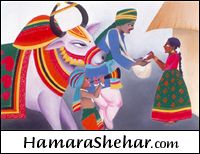 The word Sankranti (Sanskrit) (Lit. "transition") is celebrated in the month of Magha (Lunar calendar) marking the northward passage of the Sun through Winter Solstice. Sankranti heralds warmer summer months.
In Southern India, the entire month preceding Sankranti is called Dhanurmasam and is considered an auspicious period of preparation of Sankranti.
Courtsey: Nagarjuna Group |
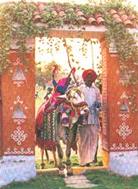
Sankranti is primarily celebrated throughout India as a harvest festival, when much merrymaking is in order. Hindus everywhere express gratitude to the elements of nature, which help nurture and enrich human lives. Exquisite Rangolis made with rice flour and flowers are created afresh everyday, in front of each dwelling.
The fact that this day is replete with historic and mythological(*) references that date back to over five thousand years—coupled with the fact that one needs persistent astronomical observations with accurate calculations in physics and mathematics—highlights the fact that Hindu festivals scientifically recognise nature's cycles and keep the physical and spiritual self in line with it: the practice is a classic example of the term "Sanaatana Dharma", which propounds the concept of living in harmony with nature.
Courtsey: Nagarjuna Group |
All over India, this day marks with rituals that involve bathing, cuisine that includes fresh harvest produce and sugars, bright and colorful decorations, devotional music and dance. The diverse regional variations of the occasion still reflect the unity in the basic concepts and understanding of nature.
In Andhra Pradesh, the celebrations are spread over four days.
On Bhogi, the first day, special blessings are showered on children: in the form of senagalu, (soaked whole gram), sugar cane, diced coconut core and copper coins to mark auspicious blessings on them.
On Sankranti day the attention shifts to newly married daughters and sons-in-law, and other family members. A splendid feast is shared by all after the "Ishta Devata" pujas.
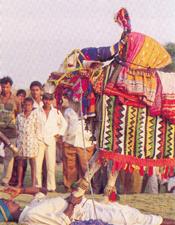
On Kanuma, the third day, attention turns to people who have served society during the year. Farmers are given special baths. Cattle are decorated and worshipped on this day. Servants are given new clothing or other gifts.
During the first three days, young girls set up exhibitions of their dolls.
Courtsey: Nagarjuna Group |
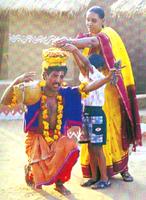
On Mukkanuma, the fourth day, the women and children take a pair of the dolls in procession to the river and put them in a boat to cross the water. This ritual signifies the sun's journey across the sky.
Traditional folk singers such as the Daasarlu and Haridaasulu sing songs as trained oxen dance to their tunes. Grand Poojas are performed in temples and devotees are given pongali (cooked sweet rice) as prasadam (nutritional spiritual offering.)
Courtsey: Nagarjuna Group |
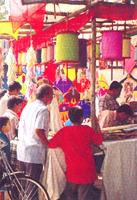
Kites are flown this day, symbolically depicting our existence, as we fly high in the winds of illusion, secured by the string that tethers us to the ground is none other than the eternal bond between us and our divine self. Kites of all sizes and colours are flown, making it a favourite festival among the children. Competitions are held throughout the region - a visual experience that draws people on their terraces and open grounds to witness the riot of colours.
We wish you all an extremely happy and auspicious Sankranti.
(*) Mahabharata (3102 BC): 'Pitama' Bheeshma, grandsire of Pandavas and Kauravas, chose to die on his bed of arrows, this day. Hindus consider this day auspicious and that those who die on this day gain immediate 'self-realization' and will never have to take birth again.
|
|
|