Hyderabad brings visions of latest autos zipping and criss-crossing across fly-overs. The picture gives an impression of a modern, fast paced city. But let us step back a moment and see what went into making this great metropolis, Hyderabad, that is the capital of Andhra Pradesh.
The Qutb Shahis
 Hyderabad was wrestled from the Bahamanis in 1512 but was really established around 1591 by Muhammad Quli Qutb Shah, with Golconda as the Qutb Shahi Sultans' base.
Golconda gradually proved inadequate as their kingdom's capital as it caved under a series of epidemics of plague and cholera. The fifth Quli then established the city of Hyderabad, which was planned around the Charminar, an architectural structure with open arches pointing to four directions and four minarets, located on the east of Musi River. Hyderabad lost its original beauty and glory after 1685, with the Mughal occupation under Aurangzeb, which resulted in plunder and destruction.
The Nizams
 Hyderabad was later founded by Nizam-ul-Mulk (Mir Qamar-ud-Din), who was viceroy of the Deccan under the Mughal emperors from 1713 to 1724. He founded the dynasty of the Nizams of Hyderabad who comprised a Muslim dynasty that had ruled over a predominantly Hindu population. The Hindu subjects over the years had made no effort to evict the Muslim aristocracy either by allying themselves with the Marathas, Mysore or with the European powers.
 The Nizams were known to amass and hoard unimaginable wealth while the subjects lived in abject poverty. It was from the Golconda Fort that the world-famous Koh-I-Noor diamond came.
The nineteenth century saw Hyderabad expanding to the north of the old city across the Musi. The chaos in administrative affairs surfaced when European powers showed up on the Indian scene.
The British
In 1798, the British forces, as part of their presence in the dominion, established a cantonment further north to Hyderabad - Secunderabad, after Sikander Jahi, then ruling Nizam. 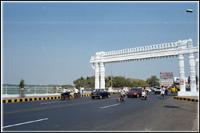 Secunderabad continues to be known as 'Lashkar' (army) by the local residents because of the cantonment. Secunderabad is connected to Hyderabad by a mile-long bund (embankment) on the Hussain Sagar. Today, this bund serves as a promenade and is the pride of the city. The cities of Hyderabad and Secunderabad grew together and came to be known as Twin Cities. People have a tendency to refer to Secunderabad as Hyderabad. Secunderabad is known to tourists more for its railway station than for its tourist attractions.
Post Partition
 When the Indian subcontinent was partitioned in 1947, Nizam Usman Ali, elected to retain an independent status rather than join India; as a result, Indian troops were withdrawn from Hyderabad. While difficulties persisted, the Nizam continued his efforts to assert his autonomy; India insisted that Hyderabad join India.
India invaded Hyderabad on September 13, 1948: within four days Hyderabad acceded to India. A popular ministry and legislature were set up in the state in March 1952. On November 1, 1956, the state of Hyderabad was divided (along linguistic lines) among the states of Andhra Pradesh (which took the Telangana districts, retaining Hyderabad city as its capital) Mysore (which took the Kannada-speaking districts) and Bombay.
Infrastructure
Hyderabad has excellent road and rail transport facilities connecting other cites of India. Hyderabad has an airport connecting both domestic as well as International destinations.
Osmania University, established by the Nizam in 1918, is now one of the best universities in India. The University of Hyderabad was established in 1974; an agricultural university and a number of advanced research and training institutes are also located here. There are other non-governmental institutions, such as the American Studies Research Center and the German Institute of Oriental Research.
 The city abounds in public and private cultural organizations, such as state-sponsored dramatic, literary, and fine arts academies. The public auditorium, Ravindra Bharati, provides a venue for dance and music festivals, and the Salar Jung museum has a unique collection of rare pieces, including jade, jewelry, paintings and furniture.
Radio and television media from the city has effected a rural-urban cultural exchange-rural residents becoming acquainted with the classical culture, city dwellers learning about folklore and folk art. Of late the cable technology, with misguided priorities, seems to ape more at alien pop cultures than do anything in preserving this valuable heritage.
'Tastes' of Hyderabad
No visit to Hyderabad is complete without having tasted its fiery Haleem. Lukmi, Kucchey Ghosth ki Biryani, Mirch Ka Salan, Chicken/ Sheer Korma, Khubani Ka Mittha, Double Ka Mittha, Akbari and Gajar Ka Halwa. Thank the stars the cable culture cannot alter the yearnings of the palate! And of course the any-time favorite with all Hyderabadis - Irani-chai cannot be ignored! This purely Irani tradition of drinking chai is a spillover from Irani trade in the 1600s.
Public Attractions
 The average Hyderabadi finds the Public Gardens, which boasts of an open-air theater, a great spot for recreational facilities though there are many parks and large parade grounds in Secunderabad. The most common picnic spots for visitors are the zoological gardens and the university's botanical gardens.
Though there is a racecourse in Hyderabad, the state is well known for the support it gives the most popular game - cricket!
Trade
Hyderabad is also synonymous with the lustrous gleaming gems of the sea - the pearls. Hyderabad, though far from the sea coast, is known for pearls solely due to the erstwhile Hyderabad state's Nizam's fancy for this lustrous, pristine creamy bead. His love for pearls was a very natural reason for pearl merchants all over India to flock to Hyderabad to satisfy his desire. This patronage contributed in making Hyderabad the largest trading center of pearls, not only in India, but also in the world.
The most convenient period to visit Hyderabad is winter, which typically lasts from October through March. Avoid trips in Summer (temperatures are known to soar over 105F(40C)) and monsoon.
A City Geared for Growth
Hyderabad brings visions of latest autos zipping across criss-crossing flyovers. The picture gives an impression of a fast paced, modern city. The technological boost Chief Minister Chandrababu Naidu is currently giving the city to bring it into sync with the internet savvy world has prompted it to be nicknamed Cyberabad. The metropolis is definitely no longer a Nizam's domain. Hyderabad today boasts of a giant facility near the outskirts called the 'Hitec City', a brainchild of Chandrababu Naidu, who is the de facto CEO of Andhra Pradesh. Given this initiative towards development, Hyderabad has been selected by Microsoft Corporation to have its software development center outside USA.
Welcome. Welcome to hamara shehar Hyderabad...
Take full advantage of all the features of this site.
|